The utility of this proposal is to provide a means for materially reducing the Infrastructure cost and Network burden of established networks of Subscriber VoD services. It does not endeavor to replace VoD. It is a hybrid extension to the current methodology. It does so in a manner that reduces costs by orders of magnitude, targeting the highest volumes of content in an inefficient content delivery system.
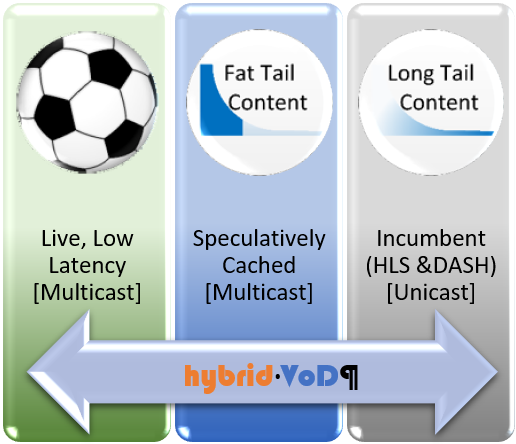
The premise of Hybrid SVoD is to combine conventional VoD with local playout of speculatively cached content delivered by a Multicast means. Multicast delivery of High Demand Live content integrates the functional trio. Hybrid SVoD covers these three use cases in a functionally integrated manner.
Hybrid SVoD provides the following:
- Live, Low latency SVoD service.
Ideal for high demand “Spectacle” content. - Speculatively Cached VoD service.
Ideal for high demand “Fat Tail” content. - Incumbent SVoD service. Ideal for “Long Tail” content.
The most essential of the three services. The fallback service when the above means are not available.
Live and Speculatively Cached content is integrated with the incumbent VoD application. The subscriber is presented a user interface that is not materially different from the familiar VoD experience currently used by the current Unicast implementation. A common presentation is desirable as the subscriber need not be concerned with the arcane athletics of the asset delivery.
The Content Service Provider retains their distinctive look, feel and branding that is their distinctive product. The local cached content would be transparently integrated into the viewing experience when it is accessible. The Subscriber would remain largely unaffected by this cost saving hybridization.
There is one important exception that should be noted. The ability for the user to Start, Stop Fast-Forward, Rewind, Skip and Review would be substantially improved for locally cached content. The current VoD operation, with its long round trip network latency, makes these controls at best, user unfriendly. At worst, user antagonistic.
Without this enormous latency in VoD control of these functions, the user experience would be greatly improved.
Details regarding the Integration and embodiments of the three services that comprise Hybrid SVoD are provided in the Whitepaper.
The Whitepaper is available below.

A page will open on new tab
 Hybrid VoD